

“You’re gonna be trouble,” my (now) wife said to me shortly after we first met.
“Yep,” was my only response.
If you’ve known me for more than a few seconds, you know that I proudly identify as a troublemaker—and have for pretty much my entire professional career.
OG troublemaker
Waaaaay back in 2009 (now I’m dating myself) I was part of a selective leadership institute for emerging IT and library leaders.
When we registered, we had the opportunity to select ribbons to attach to our name badges—common today, but quite new at the time.
My fellow institute members and I rifled through the ribbon options, contemplating how we wanted to identify ourselves for the two-week experience. The second I saw the TROUBLEMAKER ribbon, my choice was clear.
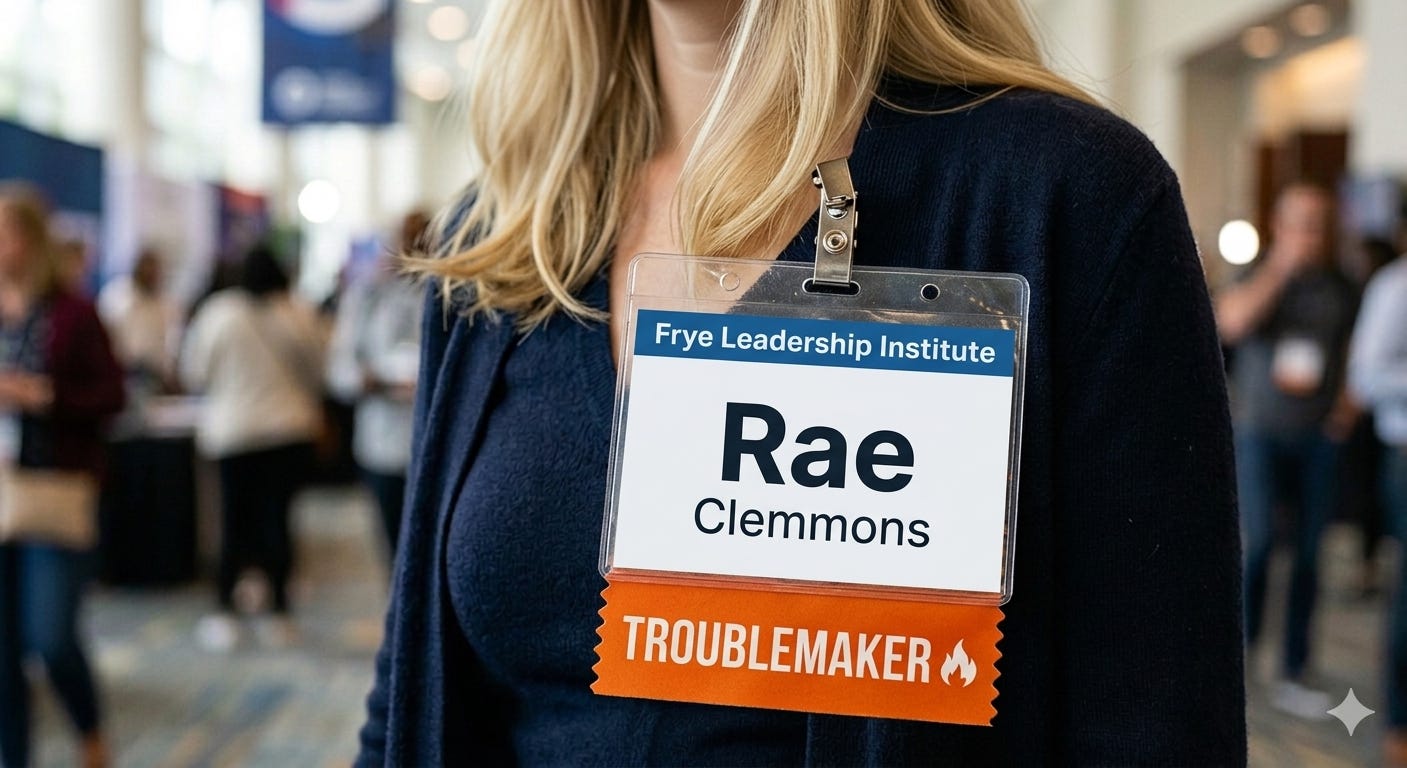
I haven’t thought about that experience in quite a while, nor have I given much thought to my leadership philosophy recently.
A badge of honor
And then I started listening to Make Trouble by Cecile Richards—because how could I not with a title like that?
She describes herself as a lifelong troublemaker, a a badge of honor that means:
“Taking on the powers that be, being a thorn in someone’s side, standing up to injustice, or just plain raising hell.” - Cecile Richards
Sometimes it’s “pretty damn awesome,” she says, and “other times it’s scary.” It’s probably a little of both most of the time.
It’s also something we don’t do enough of, because making trouble comes with risk. Political capital. Strained relationships. It could even cost you your job—or your life.
And yet, perhaps now more than ever, we have to make trouble anyway.
As I’m writing this—sitting with my wife on a Saturday morning in our favorite neighborhood coffee shop—people are organizing down the street for No Kings Day.
They, and millions of other like-minded citizens across the U.S., are making a little trouble today. Maybe you are too. Good for them (and you).
Good trouble
Making trouble isn’t only for politics. As leaders, we can and should all be troublemakers, “raising hell” when the situation calls for it.
Like when Costco refused to drop its DEI initiatives. Or when Anthropic stood up to the Pentagon. It wasn’t just the right thing to do; it was good for business. Go figure.
Your form of troublemaking may not be as public as these examples. But it doesn’t make it any less important. It might look like:
Standing up for equitable treatment of your team members.
Refusing to do business with companies that don’t have the same values as you.
Ensuring products are deployed ethically and responsibly.
Because that’s what leadership requires—holding ourselves and our organizations accountable to doing what’s right for our employees, our businesses, and our communities.
So—what kind of trouble are you going to make this week?
Bonus reads: Sometimes there is only one right answer—and we have a responsibility to say so.


We had 500 at No Kings in Paris! Here’s to making good trouble